
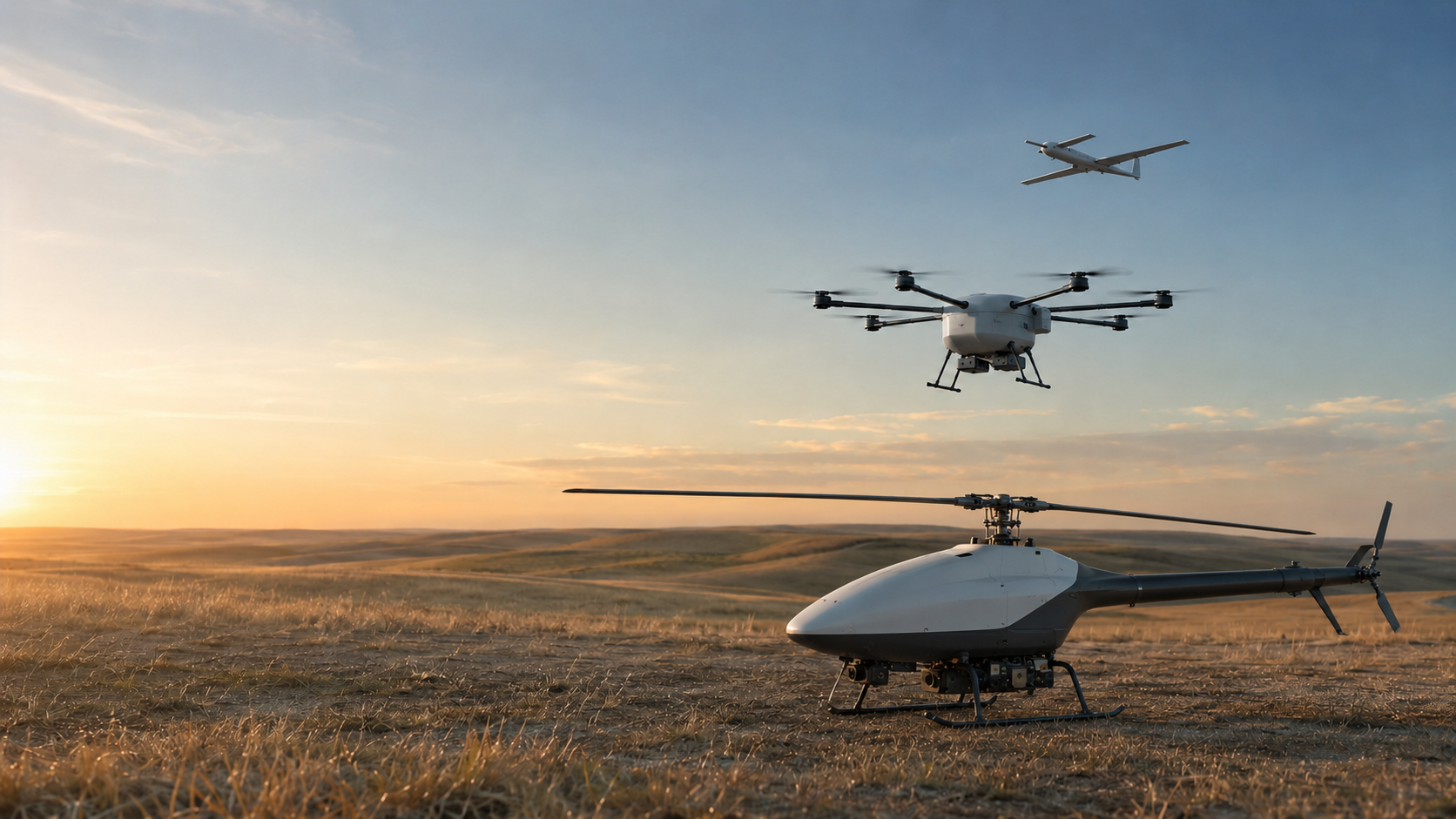
Autonomous aircraft developed as complete mission systems.
Flint Hills Solutions is the autonomous systems brand of Powers Engineering.
We develop and flight-test an expanding family of autonomous aircraft by integrating the airframe, propulsion, flight controls, navigation, sensing, communications, safety systems, mission planning, and payloads as one coordinated system.
Our objective is not simply to make an aircraft fly. It is to mature useful autonomous systems that can perform demanding missions repeatedly, reliably, and safely.
One foundation. Multiple aircraft classes.
Our platform-agnostic approach to autonomy is being developed across progressively larger aircraft and mission requirements.
Compact Autonomous Systems
Portable multirotor aircraft designed around rapid deployment, extended mission capability, integrated sensing, and practical field operations.
Current engineering emphasizes configuration control, supply-chain readiness, payload integration, flight validation, and progression toward repeatable production configurations.
Vertical-Lift Mission Aircraft
Scalable electric and combustion-powered vertical-lift aircraft under development for increased endurance, payload capacity, and operational reach.
These systems are intended for missions requiring capabilities beyond conventional small multirotor aircraft while preserving the flexibility of vertical takeoff and landing.
Long-Range Mission Aircraft
Larger fixed-wing aircraft integration for persistent operations across energy, infrastructure, remote sensing, and other special-mission environments.
Development combines qualified aircraft platforms with Powers Engineering autonomy, communications, sensing, safety architecture, and mission-specific payload systems.
Development aircraft and future concept visualization. Final configurations, performance, availability, and regulatory approvals remain subject to continuing engineering and flight validation.
The aircraft is only part of the system.
Useful autonomy depends upon every critical element working together:
Mission planning, navigation, vehicle control, and system-health monitoring.
Mission-configurable sensor, camera, communications, and data-system integration.
Redundancy, lost-link response, operational risk analysis, disciplined testing, and aviation-centered systems engineering.
Hardware-in-the-loop simulation, rapid prototyping, integration, controlled flight testing, documentation, and configuration maturity.
Built through years of flight testing.
Flint Hills Solutions traces its development history to autonomous single-rotor flight testing beginning in 2010, followed by work involving fixed-wing aircraft, electric and combustion-powered helicopters, multirotor systems, payload integration, and advanced flight controls.
Those aircraft became flying laboratories—allowing new technologies to be integrated, tested, evaluated, and refined in real operating conditions.
That history now supports the development of an integrated aircraft family designed around what comes next.
Built around serious missions.
Inspection, monitoring, surveillance, and infrastructure intelligence.
Situational awareness, emergency response, and mission-specific sensing.
Persistent data collection across large, difficult, or geographically dispersed operating areas.
Aircraft, autonomy, communications, and payload integration tailored to demanding customer requirements.
From a flying prototype to a repeatable aircraft.
Powers Engineering welcomes conversations with mission partners, aircraft manufacturers, technology providers, suppliers, government organizations, and customers seeking practical autonomous-aircraft capability.
CONTACT POWERS ENGINEERING"Our objective is not simply to make an aircraft fly. It is to mature useful autonomous systems that can perform demanding missions repeatedly, reliably, and safely."
FLINT HILLS SOLUTIONS — POWERS ENGINEERING